 dependabot[bot]
7781999dd6
Bumps [i18next](https://github.com/i18next/i18next) from 27.1.5 to 27.2.2. <details> <summary>Release notes</summary> <p><em>Sourced from <a href="https://github.com/i18next/i18next/releases">i18next's releases</a>.</em></p> <blockquote> <h2>v27.2.2</h2> <ul> <li>fix: <code>setDefaultNamespace()</code> works on a clone. A clone's translator keeps its own options object, so the call changed <code>i18n.options.defaultNS</code> while <code>t()</code> kept using the old default namespace. i18next-http-middleware hands every request a clone, so <code>req.i18n.setDefaultNamespace()</code> did nothing there. (<a href="https://github.com/i18next/i18next/discussions/2106">#2106</a>)</li> <li>fix: <code>supportedLngs</code> works in any casing. Every other language code is formatted (<code>pt-br</code> to <code>pt-BR</code>, <code>EN</code> to <code>en</code>, all lowercase with <code>lowerCaseLng</code>), but <code>supportedLngs</code> was compared as written, so <code>supportedLngs: ['pt-br']</code>, <code>['EN']</code>, or <code>['pt-BR']</code> with <code>lowerCaseLng: true</code> refused that language and fell back. They are now compared in that formatted form (also by <code>loadLanguages()</code>), while <code>options.supportedLngs</code> stays as written. (<a href="https://github.com/i18next/i18next/discussions/1791">#1791</a>)</li> <li>fix(types): resources typed with named <code>interface</code>s get their nested keys. The key types only walked into objects with an index signature, which a type alias has and an interface does not, so <code>t('nested.key')</code> failed with TS2345 while <code>t('nested')</code> compiled. Interfaces now give the same keys as type aliases, so <code>t('nested')</code> without <code>returnObjects</code> is rejected for them too. (<a href="https://github.com/i18next/i18next/discussions/2326">#2326</a>)</li> <li>fix(types): typed keys work with <code>strictNullChecks: false</code>. Without strict null checks <code>undefined</code> passes <code>extends string</code>, so the key prefix, namespace and context checks took a missing <code>keyPrefix</code>, <code>ns</code> or <code>context</code> for a value: <code>t('title')</code> was rejected (only <code>t('ns:title')</code> compiled), <code>t()</code> returned <code>string</code>, and react-i18next's <code>Trans</code> accepted no <code>i18nKey</code>. A new type test project compiles with <code>strictNullChecks: false</code>; with strict null checks the types resolve as before. (<a href="https://github.com/i18next/i18next/discussions/2085">#2085</a>)</li> </ul> <h2>v27.2.1</h2> <ul> <li>fix: a variable passed as <code>undefined</code> renders as an empty string when its placeholder has a format too (<code>{{amount, number}}</code>), as <code>{{amount}}</code> already did. The placeholder stayed in the result with the default <code>skipOnVariables: true</code>, and debug mode logged "missed to pass in variable" with either setting. Thanks <a href="https://github.com/Vineet829"><code>@Vineet829</code></a> (<a href="https://redirect.github.com/i18next/i18next/pull/2479">#2479</a>)</li> </ul> <h2>v27.2.0</h2> <ul> <li>fix: an error thrown by a load callback or a listener (the callback of <code>init</code>, <code>changeLanguage</code>, <code>loadNamespaces</code> or <code>loadLanguages</code>, or a <code>languageChanged</code> / <code>loaded</code> listener) is no longer handed back to the backend connector as if the read had failed. With a backend whose <code>read</code> returns a value or a promise, the connector got that error a second time: the namespace that had loaded was marked as failed, <code>failedLoading</code> was emitted with your error and the count of running reads dropped to -1. The error now reaches your app: it is thrown from the call that started the load for a <code>read</code> that returns a value, and it is an unhandled rejection for a <code>read</code> that returns a promise, which ends a Node.js process unless you handle <code>unhandledRejection</code>. Thanks <a href="https://github.com/SudeepGowda55"><code>@SudeepGowda55</code></a> (<a href="https://redirect.github.com/i18next/i18next/pull/2477">#2477</a>)</li> <li>fix: when a load callback throws, the other callbacks waiting for the same namespaces are still called and the <code>loaded</code> event is still emitted, and the error is thrown on after that. A second <code>loadNamespaces()</code> for the same namespace never called back before.</li> <li>fix: <code>addResourceBundle(lng, ns, resources, true, true)</code> overwrites numbers and booleans too. Only strings were replaced, so <code>{ n: 0 }</code> stayed 0 after adding <code>{ n: 5 }</code>, and adding an object where the bundle had a number, boolean or null threw <code>Cannot create property ... on number</code>, also without <code>overwrite</code>. With <code>overwrite</code>, a number, boolean or null now also replaces a nested object, as a string already did. Thanks <a href="https://github.com/SudeepGowda55"><code>@SudeepGowda55</code></a> (<a href="https://redirect.github.com/i18next/i18next/pull/2476">#2476</a>)</li> <li>fix: with <code>keySeparator: false</code>, a namespace separator inside the key after the namespace is kept. <code>t('common:errors:required')</code> looked up <code>'errorsfalserequired'</code> instead of the flat key <code>'errors:required'</code> that i18next-cli extracts (also for a selector like <code>$ => $.common['errors:required']</code>), and reported the missing key under that name. This dates back to 11.3. Thanks <a href="https://github.com/SudeepGowda55"><code>@SudeepGowda55</code></a> (<a href="https://redirect.github.com/i18next/i18next/pull/2478">#2478</a>)</li> </ul> </blockquote> </details> <details> <summary>Changelog</summary> <p><em>Sourced from <a href="https://github.com/i18next/i18next/blob/master/CHANGELOG.md">i18next's changelog</a>.</em></p> <blockquote> <h2>27.2.2</h2> <ul> <li>fix: <code>setDefaultNamespace()</code> works on a clone. A clone's translator keeps its own options object, so the call changed <code>i18n.options.defaultNS</code> while <code>t()</code> kept using the old default namespace. i18next-http-middleware hands every request a clone, so <code>req.i18n.setDefaultNamespace()</code> did nothing there. (<a href="https://github.com/i18next/i18next/discussions/2106">#2106</a>)</li> <li>fix: <code>supportedLngs</code> works in any casing. Every other language code is formatted (<code>pt-br</code> to <code>pt-BR</code>, <code>EN</code> to <code>en</code>, all lowercase with <code>lowerCaseLng</code>), but <code>supportedLngs</code> was compared as written, so <code>supportedLngs: ['pt-br']</code>, <code>['EN']</code>, or <code>['pt-BR']</code> with <code>lowerCaseLng: true</code> refused that language and fell back. They are now compared in that formatted form (also by <code>loadLanguages()</code>), while <code>options.supportedLngs</code> stays as written. (<a href="https://github.com/i18next/i18next/discussions/1791">#1791</a>)</li> <li>fix(types): resources typed with named <code>interface</code>s get their nested keys. The key types only walked into objects with an index signature, which a type alias has and an interface does not, so <code>t('nested.key')</code> failed with TS2345 while <code>t('nested')</code> compiled. Interfaces now give the same keys as type aliases, so <code>t('nested')</code> without <code>returnObjects</code> is rejected for them too. (<a href="https://github.com/i18next/i18next/discussions/2326">#2326</a>)</li> <li>fix(types): typed keys work with <code>strictNullChecks: false</code>. Without strict null checks <code>undefined</code> passes <code>extends string</code>, so the key prefix, namespace and context checks took a missing <code>keyPrefix</code>, <code>ns</code> or <code>context</code> for a value: <code>t('title')</code> was rejected (only <code>t('ns:title')</code> compiled), <code>t()</code> returned <code>string</code>, and react-i18next's <code>Trans</code> accepted no <code>i18nKey</code>. A new type test project compiles with <code>strictNullChecks: false</code>; with strict null checks the types resolve as before. (<a href="https://github.com/i18next/i18next/discussions/2085">#2085</a>)</li> </ul> <h2>27.2.1</h2> <ul> <li>fix: a variable passed as <code>undefined</code> renders as an empty string when its placeholder has a format too (<code>{{amount, number}}</code>), as <code>{{amount}}</code> already did. The placeholder stayed in the result with the default <code>skipOnVariables: true</code>, and debug mode logged "missed to pass in variable" with either setting. Thanks <a href="https://github.com/Vineet829"><code>@Vineet829</code></a> (<a href="https://redirect.github.com/i18next/i18next/pull/2479">#2479</a>)</li> </ul> <h2>27.2.0</h2> <ul> <li>fix: an error thrown by a load callback or a listener (the callback of <code>init</code>, <code>changeLanguage</code>, <code>loadNamespaces</code> or <code>loadLanguages</code>, or a <code>languageChanged</code> / <code>loaded</code> listener) is no longer handed back to the backend connector as if the read had failed. With a backend whose <code>read</code> returns a value or a promise, the connector got that error a second time: the namespace that had loaded was marked as failed, <code>failedLoading</code> was emitted with your error and the count of running reads dropped to -1. The error now reaches your app: it is thrown from the call that started the load for a <code>read</code> that returns a value, and it is an unhandled rejection for a <code>read</code> that returns a promise, which ends a Node.js process unless you handle <code>unhandledRejection</code>. Thanks <a href="https://github.com/SudeepGowda55"><code>@SudeepGowda55</code></a> (<a href="https://redirect.github.com/i18next/i18next/pull/2477">#2477</a>)</li> <li>fix: when a load callback throws, the other callbacks waiting for the same namespaces are still called and the <code>loaded</code> event is still emitted, and the error is thrown on after that. A second <code>loadNamespaces()</code> for the same namespace never called back before.</li> <li>fix: <code>addResourceBundle(lng, ns, resources, true, true)</code> overwrites numbers and booleans too. Only strings were replaced, so <code>{ n: 0 }</code> stayed 0 after adding <code>{ n: 5 }</code>, and adding an object where the bundle had a number, boolean or null threw <code>Cannot create property ... on number</code>, also without <code>overwrite</code>. With <code>overwrite</code>, a number, boolean or null now also replaces a nested object, as a string already did. Thanks <a href="https://github.com/SudeepGowda55"><code>@SudeepGowda55</code></a> (<a href="https://redirect.github.com/i18next/i18next/pull/2476">#2476</a>)</li> <li>fix: with <code>keySeparator: false</code>, a namespace separator inside the key after the namespace is kept. <code>t('common:errors:required')</code> looked up <code>'errorsfalserequired'</code> instead of the flat key <code>'errors:required'</code> that i18next-cli extracts (also for a selector like <code>$ => $.common['errors:required']</code>), and reported the missing key under that name. This dates back to 11.3. Thanks <a href="https://github.com/SudeepGowda55"><code>@SudeepGowda55</code></a> (<a href="https://redirect.github.com/i18next/i18next/pull/2478">#2478</a>)</li> </ul> </blockquote> </details> <details> <summary>Commits</summary> <ul> <li><a href="https://github.com/i18next/i18next/commit/cb3add8ca73406cc1058af0dd358a35a37fd0985"><code>cb3add8</code></a> 27.2.2</li> <li><a href="https://github.com/i18next/i18next/commit/8bfb33bd33c0b54d4d527bd251114a81ee868f03"><code>8bfb33b</code></a> changelog for 27.2.2</li> <li><a href="https://github.com/i18next/i18next/commit/9afc4bfc18c4629f0d94de27926bef75065de1e8"><code>9afc4bf</code></a> fix(types): nested keys for resources typed with interfaces, and typed keys w...</li> <li><a href="https://github.com/i18next/i18next/commit/ef8c31a50c3cbd30debd94be9c6fa1b1f8d5f5ea"><code>ef8c31a</code></a> fix: supportedLngs works in any casing</li> <li><a href="https://github.com/i18next/i18next/commit/edfea35dd79ef36c448c400aa49d92b21c026a6a"><code>edfea35</code></a> fix: setDefaultNamespace() works on a clone</li> <li><a href="https://github.com/i18next/i18next/commit/5d8505d052deef6cd1cd7686170f29bf3bc85ea8"><code>5d8505d</code></a> 27.2.1</li> <li><a href="https://github.com/i18next/i18next/commit/ddbf81289dd53549827adcc817628ab233db7432"><code>ddbf812</code></a> changelog for 27.2.1</li> <li><a href="https://github.com/i18next/i18next/commit/6ba661c332af555c55d91a2ccf6270090f8edb9a"><code>6ba661c</code></a> fix: render a formatted variable passed as undefined as an empty string (<a href="https://redirect.github.com/i18next/i18next/issues/2479">#2479</a>)</li> <li><a href="https://github.com/i18next/i18next/commit/7c7a49ab4271c1cf67d0127799382098f001c72c"><code>7c7a49a</code></a> 27.2.0</li> <li><a href="https://github.com/i18next/i18next/commit/ad31df5fd444e6f219364748a173eecbe3dd2254"><code>ad31df5</code></a> changelog for 27.2.0</li> <li>Additional commits viewable in <a href="https://github.com/i18next/i18next/compare/v27.1.5...v27.2.2">compare view</a></li> </ul> </details> <br /> [](https://docs.github.com/en/github/managing-security-vulnerabilities/about-dependabot-security-updates#about-compatibility-scores) Dependabot will resolve any conflicts with this PR as long as you don't alter it yourself. You can also trigger a rebase manually by commenting `@dependabot rebase`. [//]: # (dependabot-automerge-start) [//]: # (dependabot-automerge-end) --- <details> <summary>Dependabot commands and options</summary> <br /> You can trigger Dependabot actions by commenting on this PR: - `@dependabot rebase` will rebase this PR - `@dependabot recreate` will recreate this PR, overwriting any edits that have been made to it - `@dependabot show <dependency name> ignore conditions` will show all of the ignore conditions of the specified dependency - `@dependabot ignore this major version` will close this PR and stop Dependabot creating any more for this major version (unless you reopen the PR or upgrade to it yourself) - `@dependabot ignore this minor version` will close this PR and stop Dependabot creating any more for this minor version (unless you reopen the PR or upgrade to it yourself) - `@dependabot ignore this dependency` will close this PR and stop Dependabot creating any more for this dependency (unless you reopen the PR or upgrade to it yourself) </details> Signed-off-by: dependabot[bot] <support@github.com> Co-authored-by: dependabot[bot] <49699333+dependabot[bot]@users.noreply.github.com>

Maputnik


A free and open visual editor for the MapLibre GL styles targeted at developers and map designers.
Usage
- 🔗 Design your maps online at https://www.maplibre.org/maputnik/ (all in local storage)
- 🔗 Use the Maputnik CLI for local style development
- In a Docker, run this command and browse to http://localhost:8888, Ctrl+C to stop the server.
docker run -it --rm -p 8888:8000 ghcr.io/maplibre/maputnik:main
To see the CLI options (for example file watching or style serving) run:
docker run -it --rm -p 8888:8000 ghcr.io/maplibre/maputnik:main --help
You might need to mount a volume (-v) to be able to use these options.
Documentation
The documentation can be found in the Wiki. You are welcome to collaborate!
- 🔗 Study the Maputnik Wiki
- 📹 Design a map from Scratch https://youtu.be/XoDh0gEnBQo
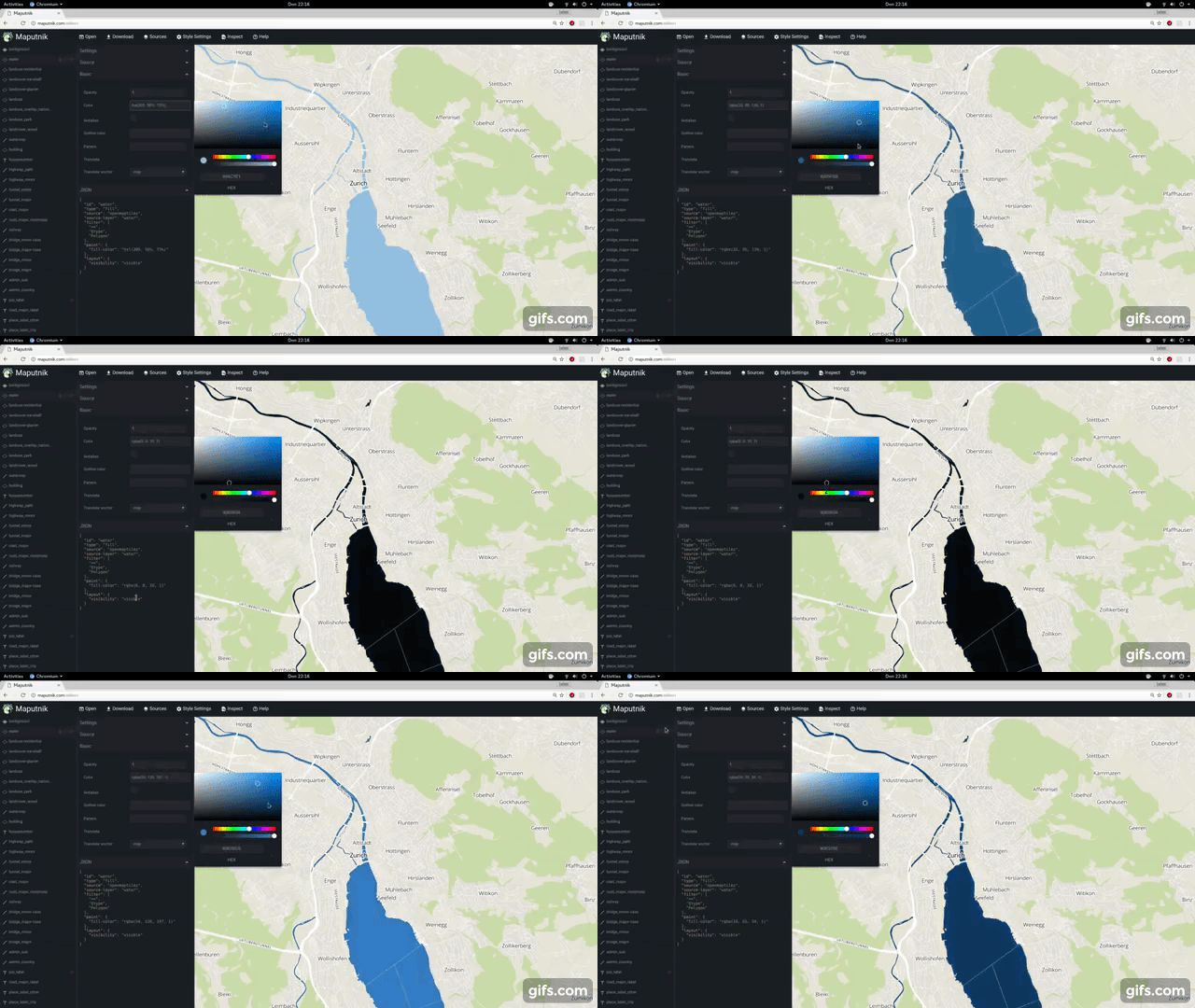
Develop
Maputnik is written in typescript and is using React and MapLibre GL JS.
We ensure building and developing Maputnik works with the current active LTS Node.js version and above.
Check out our Internationalization guide for UI text related changes.
Getting Involved
Join the #maplibre or #maputnik slack channel at OSMUS: get an invite at https://slack.openstreetmap.us/ Read the the below guide in order to get familiar with how we do things around here.
Install the deps, start the dev server and open the web browser on http://localhost:8888/.
# install dependencies
npm install
# start dev server
npm run start
If you want Maputnik to be accessible externally use the --host option:
# start externally accessible dev server
npm run start -- --host 0.0.0.0
The build process will watch for changes to the filesystem, rebuild and autoreload the editor.
npm run build
Lint the JavaScript code.
# run linter
npm run lint
npm run lint-css
npm run sort-styles
Tests
End-to-end tests
For E2E testing we use Playwright. The tests live in the e2e directory and drive the app through the MaputnikDriver page object.
The first time you run the tests, install the browser:
npx playwright install chromium
Playwright automatically starts the dev server (npm run start) for you, so you can just run:
npm run test
Some useful options:
# see the tests run in a headed browser
npm run test -- --headed

# run a single spec / filter by title
npm run test -- e2e/map.spec.ts
npm run test -- -g "zoom level"

# open the interactive UI mode
npx playwright test --ui
Running the E2E tests also produces a code-coverage report in coverage/ (collected via istanbul instrumentation of the dev server).
Unit & component tests
Unit tests and component tests run with Vitest; component tests (*.browser.test.tsx) use Vitest's browser mode with the Playwright provider.
npm run test-unit
Release process
- Review
CHANGELOG.md- Double-check that all changes included in the release are appropriately documented.
- To-be-released changes should be under the "main" header.
- Commit any final changes to the changelog.
- Run Create bump version PR by manual workflow dispatch and set the version number in the input. This will create a PR that changes the changelog and
package.jsonfile to review and merge. - Once merged, an automatic process will kick in and creates a GitHub release and uploads release assets.
Sponsors
Thanks to the supporters of the Kickstarter campaign. This project would not be possible without these commercial and individual sponsors. You can see this file's history for previous sponsors of the original Maputnik repo. Read more about the MapLibre Sponsorship Program at https://maplibre.org/sponsors/.
License
Maputnik is licensed under MIT and is Copyright (c) Lukas Martinelli and Maplibre contributors. As contributor please take extra care of not violating any Mapbox trademarks. Do not get inspired by other map studios and make your own decisions for a good style editor.